


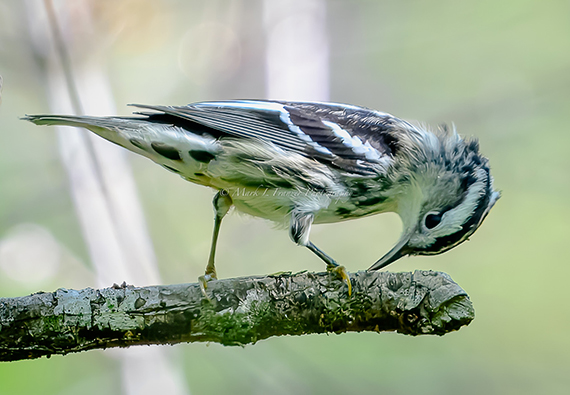
THE BLACK AND WHITE WARBLER
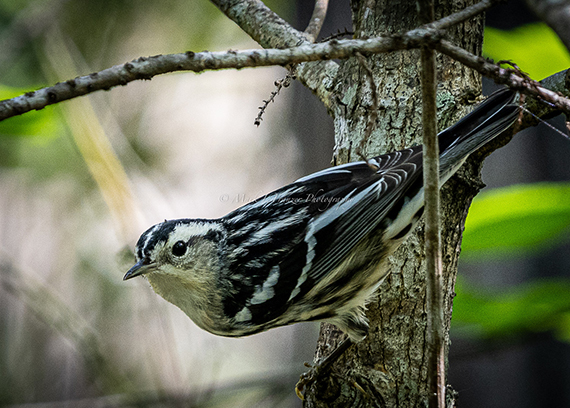
The Black-and-White Warbler is a small songbird about 4 to 5 inches long and weighing about one-half ounce, with a wingspan of up to ten inches. It is boldly patterned in black and white with a striped crown, white eyebrow, black wings with two white wing bars, and a white belly streaked with black. Breeding males have black cheeks and throat, while females and young birds have grayer cheeks and paler throats.
Unlike most warblers, this species forages like a nuthatch, creeping along tree trunks and large branches in search of insects hidden in bark. Its diet consists mainly of caterpillars, beetles, ants, spiders, and other arthropods.
Black-and-White Warblers breed across much of North America, from the northeastern United States and Canada west to parts of the central U.S. They nest on or near the ground, usually hidden at the base of trees, stumps, or fallen logs, where the female builds a small cup-shaped nest of leaves, bark, and grasses. A typical clutch contains 4–5 eggs, and the female performs most of the incubation.
They are long-distance migrants, wintering primarily in Florida, the Caribbean, Mexico, Central America, and northern South America. During spring and fall migration, they may travel through much of the eastern United States and often join mixed-species feeding flocks while stopping to refuel.