

COTTONMOUTH
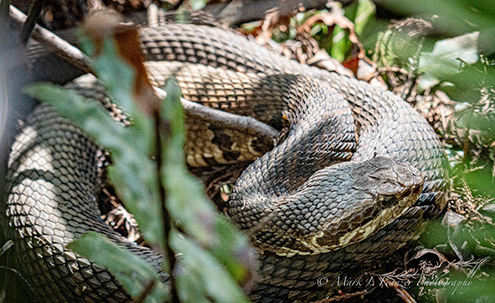
Cottonmouth (water moccasin) bites can be very dangerous to people and pets due to their potent venom, which often causes severe pain, swelling, and tissue damage. If bitten, seek immediate medical care at a hospital experienced in treating snakebites: Call 911 right away, stay calm, keep the bitten area at heart level, and avoid using tourniquets, ice, or cutting the wound.
Cottonmouths are not aggressive and typically avoid contact with humans and pets. Most bites occur when the snake is deliberately provoked or accidentally stepped on.
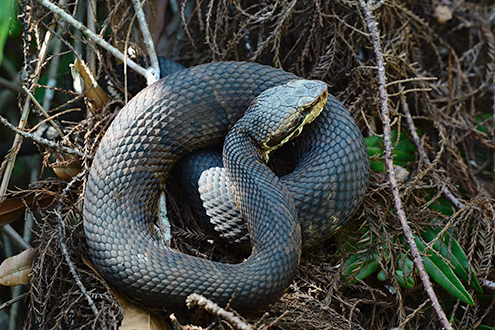
In Florida, cottonmouths are often confused with eight nonvenomous watersnakes in the genus Nerodia, which share similar habitats and appearances. Several reliable features can help distinguish them. From directly above, a cottonmouth’s eyes are not visible because they are obscured by the broad head shape and dark markings, whereas watersnake eyes are clearly visible. Cottonmouths have vertically elliptical, cat-like pupils, while watersnakes have round pupils. Cottonmouths possess a facial pit organ, a small heat-sensing pit located between the nostril and eye, which watersnakes lack. Watersnakes often display thin dark vertical lines on the sides of the face near the mouth, a pattern usually absent in cottonmouths. Cottonmouths commonly rest with their heads elevated off the ground and tilted upward at an angle, whereas watersnakes generally do not adopt this posture.
Brightly patterned juvenile Florida cottonmouths are sometimes mistaken for Eastern copperheads, which occur in Florida only in the Panhandle. The dark crossbands on juvenile cottonmouths are filled with numerous dark spots and speckles, creating a mottled appearance, while copperhead crossbands are cleaner with no dark spots or at most one. Adult copperheads retain their banded pattern throughout life, whereas adult cottonmouths often become uniformly dark with little to no visible pattern remaining. Copperhead eyes lack the prominent dark facial band that typically crosses the cottonmouth’s eye.
Always give snakes plenty of space and never attempt to handle them. Contact professionals for safe removal if needed.